
Why Allergy Meds Are Suddenly Part of the PMDD Conversation
By Micaela Riley • 28 August, 2026


Some women with severe PMS or PMDD say antihistamines are giving them surprising relief. The science is still catching up, but the hormone-histamine connection may offer a clue.
If the week before your period regularly turns you into someone you barely recognize, you don’t need me to explain how bad it can get.
It downright sucks. It can feel like someone has cranked your nervous system all the way up to MAX, and not in a fun way, while the version of you who normally handles life just fine has temporarily left the building.
When it gets that bad, you’ll try just about anything that might make you feel like yourself again. If you know, you know.
Which is why this caught my attention.
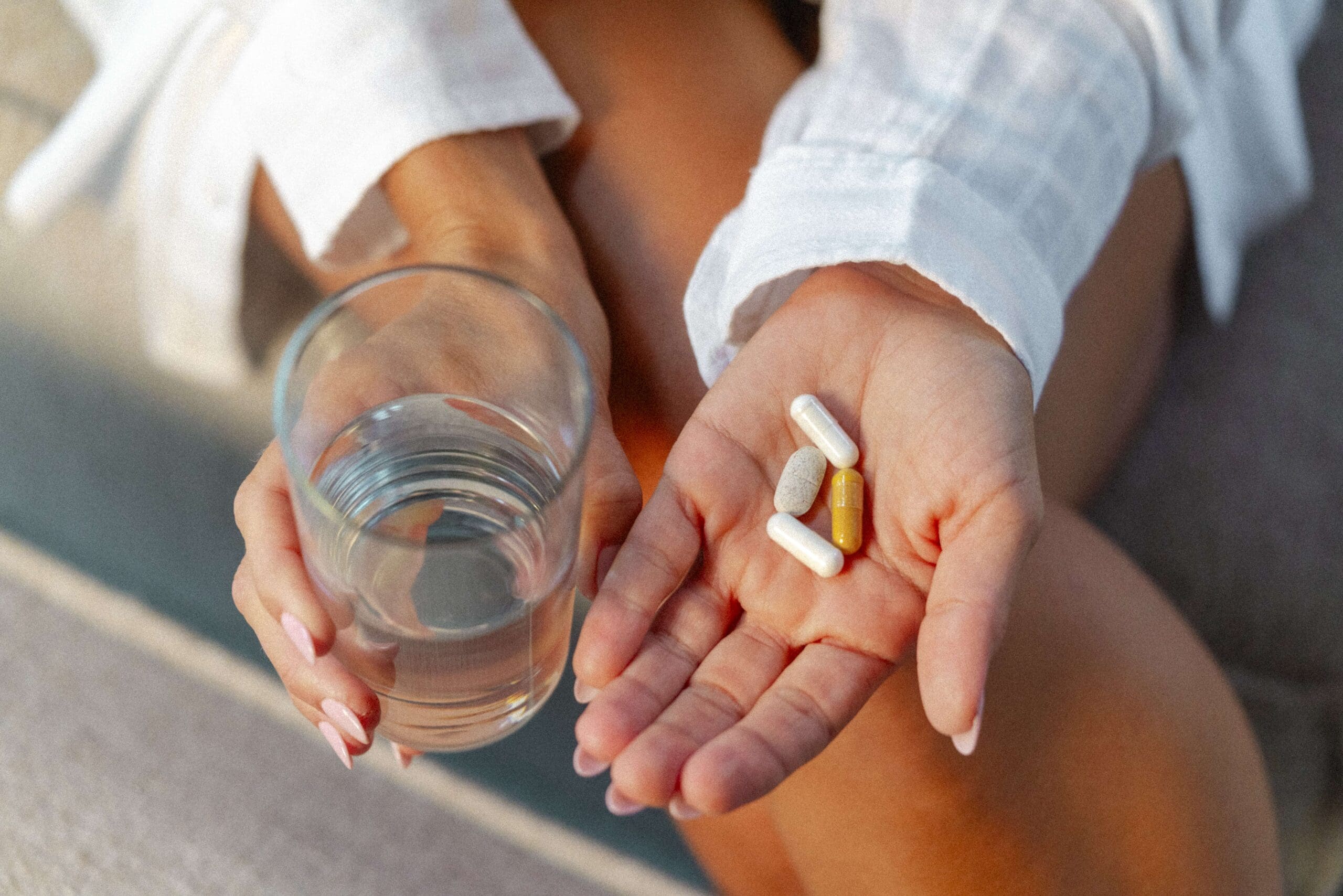
Women with severe premenstrual syndrome (PMS) or premenstrual dysphoric disorder (PMDD) are talking online about taking antihistamines during the week leading up to their period, like Allegra and Pepcid together, and some are describing surprisingly dramatic relief. One woman on TikTok even described it as “a wave of joy.”
A wave of joy. From allergy medication.
Obviously, I had questions.
Are antihistamines somehow helping PMDD?
For some women, apparently yes. For others, not at all. The much harder question is why — and that’s where the biology gets really interesting.
Before we get into the biology…
[One quick note about language: I’m going to talk mostly about PMDD because that’s where much of this conversation is happening online. But plenty of women have severe, clearly cyclical symptoms without a formal PMDD diagnosis. If you reliably feel awful at the same point in your cycle every month, this conversation may feel very familiar to you too.]
I want to be really clear about something before we start connecting hormones and histamine receptors: we don’t have randomized clinical trials showing that antihistamines treat PMDD.
None.
What we have right now is women saying, I tried this and I felt so much better.
That’s not proof that histamine causes PMDD, or even proof that histamine is the reason these medications are helping. But I also don’t think the right response is to shrug and dismiss what women are noticing because nobody has run the study yet.
This is one of those places where women are driving the scientific question themselves. When you spend part of every month feeling unlike yourself (to put it mildly), and the treatments you’ve tried haven’t gotten you where you need to be, you start paying very close attention to anything that makes a difference.
Sometimes those observations lead nowhere. Sometimes they point toward biology we haven’t understood yet.
We don’t know which one this is.
But there are a few reasons the histamine connection isn’t completely out of left field.
First, histamine isn’t just about allergies
Most of us hear histamine and think allergies. It’s that “thing that makes you sneeze.”
But histamine has a much bigger job description than that.
Histamine is a chemical messenger, and your body uses it for all sorts of things that have nothing to do with pollen. It helps influence what happens in your blood vessels, your gut, and even how awake and alert you feel.
And histamine doesn’t have just one button to push. It has several different receptors (four, actually) it can bind to, and each can trigger a different response.
Which brings us to the medications women are taking.
Allegra and Pepcid block histamine in different ways
Allegra, Claritin, and Zyrtec block H1 receptors, the ones most associated with classic allergy symptoms.
Pepcid, or famotidine, blocks a different histamine receptor, called H2.
Yes, Pepcid is a histamine blocker.
We think of it as heartburn medicine because H2 receptors help tell the stomach to make acid. But H2 receptors didn’t get the memo that they were supposed to stay in the stomach. They’re found elsewhere too.
So taking an H1 blocker with an H2 blocker means dampening two different branches of histamine signaling.
Which raises the much more compelling question: why would any of this matter before your period?
And that’s where the hormones come in.
What do hormones have to do with histamine?
Here’s where this theory starts to make a little more sense.
Your body has immune cells called mast cells that store histamine and release it when they’re triggered. Estrogen seems to make those cells a little more trigger-happy. In laboratory studies, estrogen can encourage mast cells to spill more of their allergy-producing contents.1
Estrogen may also affect what happens after histamine is released. It’s been proposed to reduce the activity of diamine oxidase, or DAO, one of the enzymes that helps clear histamine.2 The evidence here is much thinner and comes largely from animal studies, so I wouldn’t necessarily call this settled.
So it looks like hormones could be changing both how readily histamine is released and what happens to it afterward. And the next logical question is…
Do we see this in women?
The short answer is: there are hints of it.
One small study found that the skin’s response to histamine was stronger around ovulation, when estrogen peaks.3 Another found stronger allergic reactions at that same point in the cycle, even though women weren’t more sensitive to histamine itself. 4
DAO seems to shift across the menstrual cycle too. In one small study, levels were higher during the luteal phase than during the follicular phase.5 And because DAO helps clear histamine away, more DAO should, at least in theory, mean less histamine hanging around.
So this clearly isn’t as simple as estrogen rises, histamine rises. But it does suggest that both histamine signaling and histamine breakdown may change across the menstrual cycle.
In other words, estrogen and histamine biology do seem to be talking to each other. We just don’t fully understand the conversation yet.
Could some women be more histamine-sensitive?
Here’s where I’m willing to speculate a little.
Some people seem to handle histamine less gracefully than others. The term histamine intolerance is used when histamine builds up faster than the body can clear it, although the condition itself is still imperfectly defined.
Symptoms can include itching or flushing, headaches and migraines, bloating, abdominal pain, diarrhea, and sometimes a racing heart.
But here’s what I’d pay attention to: when those symptoms happen.
If they reliably flare around ovulation or in the days before your period, that pattern may be worth noticing. There is published evidence that histamine-related symptoms and mast-cell-driven conditions can shift across the menstrual cycle.6
Which makes me wonder whether the women who respond dramatically to antihistamines represent a particular subgroup.
Maybe histamine isn’t causing their PMDD at all. Maybe it’s adding another layer of symptoms during an already hormonally turbulent part of the month.
That could help explain why antihistamines feel life-changing for some women and do absolutely nothing for others.
We don’t know yet. But I’d really like to see someone study it.
What’s next? Start paying attention to the pattern
I know, I know. Everyone tells women to keep a symptom journal.
But here, the timing could actually tell us something.
For at least two cycles, track what happens and when: headaches, flushing or itching, GI symptoms, sleep, mood, reactions to alcohol or certain foods, allergy flares. Then note where you are in your cycle.
If a pattern starts to emerge, bring it to your doctor. Depending on your symptoms, it may also be worth asking whether an allergist or immunologist should be part of the conversation.
And if you decide together that an antihistamine trial makes sense, keep everything else as steady as you can so you can actually tell whether it helped.
Otherwise, you may feel better and have absolutely no idea why.
Disclaimer: This article is for educational and informational purposes only and isn’t intended to diagnose, treat, cure, or prevent any medical condition or replace individualized medical advice. Antihistamines are not an established treatment for PMS or PMDD. Always talk with your healthcare provider before starting or changing medications, supplements, hormones, or other treatments.
- Zaitsu M, Narita S, Lambert KC, Grady JJ, Estes DM, Curran EM, Brooks EG, Watson CS, Goldblum RM, Midoro-Horiuti T. Estradiol activates mast cells via a non-genomic estrogen receptor-alpha and calcium influx. Mol Immunol. 2007 Mar;44(8):1977-85. doi: 10.1016/j.molimm.2006.09.030. Epub 2006 Nov 3. PMID: 17084457; PMCID: PMC2603032.
↩︎ - Fogel WA. Diamine oxidase (DAO) and female sex hormones. Agents Actions. 1986 Apr;18(1-2):44-5. doi: 10.1007/BF01987978. PMID: 3088928.
↩︎ - Kalogeromitros D, Katsarou A, Armenaka M, Rigopoulos D, Zapanti M, Stratigos I. Influence of the menstrual cycle on skin-prick test reactions to histamine, morphine and allergen. Clin Exp Allergy. 1995 May;25(5):461-6. doi: 10.1111/j.1365-2222.1995.tb01078.x. PMID: 7553250.
↩︎ - Kirmaz C, Yuksel H, Mete N, Bayrak P, Baytur YB. Is the menstrual cycle affecting the skin prick test reactivity? Asian Pac J Allergy Immunol. 2004 Dec;22(4):197-203. PMID: 15783132.
↩︎ - Hamada Y, Shinohara Y, Yano M, Yamamoto M, Yoshio M, Satake K, Toda A, Hirai M, Usami M. Effect of the menstrual cycle on serum diamine oxidase levels in healthy women. Clin Biochem. 2013 Jan;46(1-2):99-102. doi: 10.1016/j.clinbiochem.2012.10.013. Epub 2012 Oct 22. PMID: 23099198.
↩︎ - Jackson K, Busse W, Gálvez-Martín P, Terradillos A, Martínez-Puig D. Evidence for Dietary Management of Histamine Intolerance. Int J Mol Sci. 2025 Sep 20;26(18):9198. doi: 10.3390/ijms26189198. PMID: 41009760; PMCID: PMC12470264.
↩︎

Featured Articles
Simple, sustainable habits that promote better digestion and support a healthier and balanced gut.
Simple, sustainable habits that promote better digestion and support a healthier and balanced gut.

Simple, sustainable habits that promote better digestion and support a healthier and balanced gut.

Simple, sustainable habits that promote better digestion and support a healthier and balanced gut.

Simple, sustainable habits that promote better digestion and support a healthier and balanced gut.

Simple, sustainable habits that promote better digestion and support a healthier and balanced gut.


+ Comments